
Friday, July 13, 2012

Sunday, July 8, 2012
Local Artist Interviews: Abigail Anderson - Painter - Printmaker - Multimed...
I was recently asked to participate with Local Artist Interviews, a blog dedicated to creating exposure and opportunities for Minnesota artists and organizations through interviews, grants, and networking.
Read the post here: http://www.local-artist-interviews.com/2012/07/abigail-anderson-painter-printmaker.html
Read the post here: http://www.local-artist-interviews.com/2012/07/abigail-anderson-painter-printmaker.html
Thursday, July 5, 2012
The Clearest Way, a Star Trib Art Spotlight
The Clearest Way, my three-person show with Clara Ueland and Cynthia Rae Levine at Groveland Gallery's Annex, was recommended by Star Trib arts writer Mary Abbe. Read the "Art Spotlight" article here: http://www.startribune.com/entertainment/stageandarts/161451205.html
Friday, June 8, 2012
Daily Daydreams of Minaki

What books will I read? How many times a day will I jump in the river? What birds will my dad and I see "for science"? What will become of Minaki?
Friday, April 6, 2012
Opening June 1: The Clearest Way
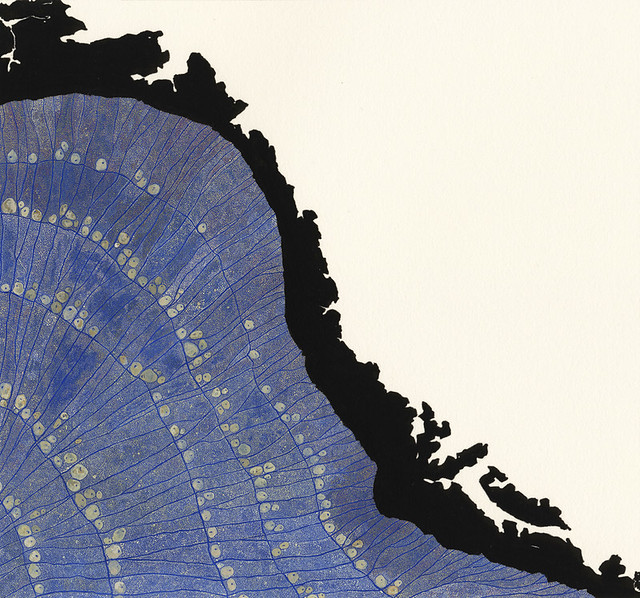
Science continues to inform Abigail Woods Anderson’s paintings and prints. Her most recent collection of compositions are inspired by the effects of Dutch elm disease on the shady boulevard near her childhood home in Minneapolis. Using tracings from the stumps leftover from the impact of the disease, as well as scientific knowledge of the boring beetle that carries the fungus from tree to tree, Anderson has created paintings that pay homage to the trees, while drawing attention to their demise. The artist explains: these paintings are embellished with patterns derived from the elm tree’s natural history and Dutch elm’s disease’s pathology. I scavenged and restyled images from botanical illustrations and figures, entomology databases, micrographs, and art history, especially landscape paintings and studies by John Constable. The resulting works are a meditation on ecology, contemplating the entangled fates of four organisms: the elm tree, the beetle, the fungus, and humans.
Sunday, March 4, 2012
Raising my glass to . . . podcasts
This weekend's painting benefited from non-stop podcasts. It was a delight to discover the conversational wisdom (and humor) of "Dame is a 4-Letter Word" & "Science... sort of."
Cheers to the podcast hosts! Slàinte!
Cheers to the podcast hosts! Slàinte!
Thursday, February 23, 2012
Description of Scolytus multistriatus
Entomologist as poet?
... frons of male is flat, oblong and hirsute; frons of female is weakly convex, weakly hirsute and sometimes glabrous; pronotum is densely punctate on upper surface; triangular scutellum densely hirsute; elytra dark red-brown, oblongly oval and bluntly rounded apices; grooves on elytra are dense, deep and sharply punctured; narrow interstices are densely puncturedSource: ForestryImages.org
Subscribe to:
Posts (Atom)